
How the Degree of Rotation Affects Price in Circulated Washington Quarters
The rotated die error happens when one of the two metal dies — the die for the front or the die for the back — moves away from its fixed position inside the big coin press machine.
These dies must be held very tightly to keep the correct position.
If one die becomes loose or is put in the machine wrongly, it can turn, and, of course, some people need a coin checker to determine the error and its degree. The US Mint tries to control this placement, but sometimes the machines fail or people make mistakes when changing the dies. This causes the die to turn at any angle from 1 degree up to 359 degrees.
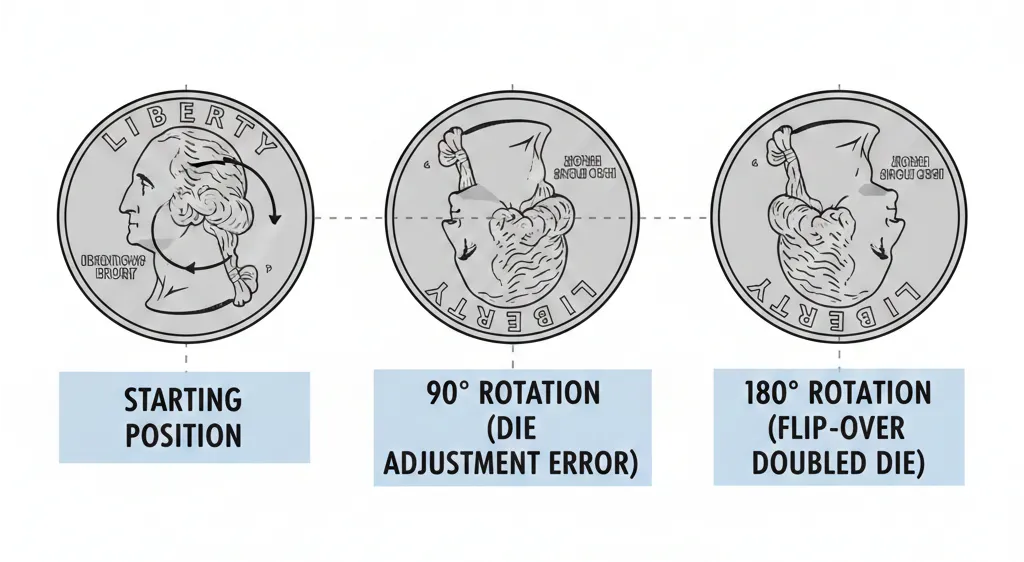
Rules for Measuring the Rotation Angle
The turning is measured clockwise, starting from the normal, correct upside-down position, which is 180 degrees.
The Normal Positions to Remember
- 0 Degrees: The back side is perfectly straight up and aligned correctly with the front side, meaning the images face the same way.
- 180 Degrees: This is the correct, standard “coin alignment” for a Washington Quarter, showing how the coin must look.
When the error happens, the back side moves from this correct 180-degree axis, turning in some way.
For example, if the back side turns 90 degrees clockwise from the correct 180-degree position, the real error angle is 90 degrees.
The movement is always measured from the perfect line, which is at 180 degrees for these quarters.
A 5-degree rotation means the back side is 5 degrees away from the correct 180-degree line.
How to Find the Angle: To find the exact angle, coin collectors use a tool called a protractor. The coin is held so the front side is perfectly straight up. Then, the coin is visually turned, and the back side’s movement can be measured by a coin values app.
A line is drawn from the coin’s perfect center to the highest part of the back image. The size of the turn away from the straight-up line is the important thing, telling us how rare the coin is.
How the Rotation Angle Affects the Collector Price
The price of circulated Washington Quarters having a rotated die error depends directly on the angle’s size.
The bigger and easier to see the rotation is, the higher the price will be, but only if the angle is in the special ranges that collectors want.
Coins used in normal buying and selling have a lower price than perfect ones, but the rule for judging the angle is always the same.
1-10 Degrees
- Error Look: In this small range, the turn is almost impossible to see with just your eyes. You need the protractor or you must look very carefully, comparing it to a coin made correctly to find this error.
- Demand and Price: Coins with such a very small rotation usually do not have a big value for collectors. A small rotation is often seen as a little mistake in making the coin, not a big defect.
The price of this coin, having been used in circulation, will only be a little higher than its 25-cent face value.
Collectors are only willing to pay a small extra amount if the coin is in very good condition, even though people used it for money.
11-45 Degrees
- Error Look: In this range, you can see the turn with a quick look, especially if you compare the coin with a correct quarter on purpose.
A turn of 30 to 45 degrees can be seen without special tools, but it is not a huge or very dramatic error.
- Demand and Price: These coins start to be interesting to collectors of errors. The price starts to go up from the face value, but the extra money is still small.
For a coin that has been used, the price will change based on how rare the year is and how good the coin looks physically.
If the coin is very worn out, the small angle of rotation will not make up for the bad quality.

The price can be from a few dollars to tens of dollars.
46-89 Degrees
- Error Look: This is the first range where the mistake is very clear and you do not need to try hard to see it. Almost half or more of the back side image is sitting at a big angle to the front side’s straight-up line.
- Demand and Price: The value of the coin increases a lot in this range. A medium rotation is quite rare and very easy to see. Coins with a turn of about 60 or 75 degrees are wanted very much because they show the error clearly.
Used coins with a 70–80-degree turn can cost from $50 to $150, depending on how good they look.
Being worn out reduces this price, but it does not take away the value completely because the error itself is a fundamental problem.
90 Degrees
- Error Look: A turn of exactly 90 degrees is one of the most important and most desired angles. In this case, the back side image is perfectly sideways compared to the straight-up front side. This is a clear, geometrically “perfect” turn.
- Demand and Price: Coins with exactly 90 degrees of rotation are more valued than coins with angles that are close but not exact. Coin collectors like the 90-degree angle because it looks balanced and the error is so obvious.
Quarters with this turn, even ones that have been used, can have a high price, often over $100–$200, depending on the year and how worn they are.
Being used in circulation, having wear and tear, can cut the price in half compared to a perfect coin.
91-179 Degrees
- Error Look: These are coins where the back side image is almost fully upside down but does not reach the perfect 180 degrees. They are very noticeable and rare errors.
- Demand and Price: The price in this range is usually very high because the closer the rotation is to 180 degrees, the more visually unique and noticeable the error looks. A quarter turned 150 degrees will cost more than a quarter with a 30-degree turn because it shows an almost complete turn-around.
Used coins in this range often cost hundreds of dollars, making them expensive items.
180 Degrees
- Error Look: This is the case where the back side is perfectly straight up and correct compared to the front side, but this is an error for quarters. As discussed in Section 2, this is not the normal way for a Washington Quarter, which must have coin alignment.
- Special Case: In the context of die rotation, a 180-degree turn from the correct position meaning a 180-degree rotation away from the 180-degree correct point means the back side will face the same way as the front side.
Such coins are extremely rare, and their cost, even if they have been used in circulation, can be very high, sometimes reaching thousands of dollars in the coin value checker app.
This 180-degree angle is one of the most valuable, along with the clean 90-degree angle, showing the biggest types of errors.
How the Circulated Status Affects Price
The fact that a Washington Quarter has been used in circulation makes the final price much lower because of these very technical reasons:
Coins that have been used always get worn out:
- The highest parts of the design, like on Washington’s face and on the eagle’s feathers, get rubbed away, making them flat.
- The surface gets covered with very small scratches from touching other coins and hard things, damaging the metal.
- The coin’s first bright shine, which is a very important part of how collectors judge value, disappears completely because of the rubbing.
Coin grading companies give these used coins low grades like AU-50, EF-45, VF-30, F-12, G-4.
The lower the grade, the lower the price is. A high collector price for an error almost always needs high quality, so having wear from circulation makes the price go down a lot.
The price of a used coin with a rotated die error is a balance between two parts:
- Good Part: The rarity and the size of the rotation angle
- Bad Part: The amount of wear and damage from being used as money
If a coin is very worn out (a low grade, for example, F-12), even a 90-degree rotation will not bring the same price as a perfect coin (UNC condition) having the same rotation. The price can be lowered by 50% or even more because of the bad condition, so collectors must decide if the error is worth the low look.
- The Problem of Checking Worn Coins: Coins that are very worn out from use can sometimes have damage that looks like an error or makes the real error hard to judge exactly.
However, for a rotated die error, the error itself comes from the coin-making process and wear cannot create it. Wear only changes how the coin looks and how much detail is left, but it does not change the angle of the turn.
The wear simply covers the beauty of the coin, making it less pretty for people buying it.
So, for used quarters, a collector wants the best mix: the biggest rotation angle possible (90° or 180°) and the least amount of wear, even though the coin was in use. Small turns (1–10 degrees) do not make up for being worn out and so have the smallest price.